Categories
AI Extensions
 2026-10-22
AI Extensions Digest: CLI-Anything turns any desktop app into an agent-callable command line
An Apache-2.0 toolkit from HKUDS that generates structured CLI harnesses around software like Blender, FreeCAD, Zotero and Zoom so agents can drive them - 56,092 GitHub stars as of October 22, 2026. I read the repo, the license and the README; I did not install or run it.
 2026-10-21
AI Extensions Digest: Sphinx, the git hook that quizzes you before your agent's code ships
A week-old, MIT-licensed pre-push hook that pauses a protected push and asks you to predict what the change does - judged by a second model that never saw the agent's conversation. 265 stars in a week. I read the repo; I did not run it.
 2026-10-20
AI Extensions Digest: Anatomy, the skill that makes your agent build isometric machines
A two-week-old Agent Skill - MIT licensed, 17,000 stars - that turns a coding agent into an illustrator of working isometric machines in SVG and WebGL, with a geometry audit that proves its own drawings. I read the repo; I did not run it.
 2026-10-19
Harness²: Google Research's framework that lets an agent rewrite its own harness
Published October 6, Apache-2.0: Harness² refines the system around a frozen model - prompts, tools, memory, skills - through a contrastive Propose-Probe-Compose loop and a persistent improvement harness. 9,061 stars and 796 forks observed October 19. The demo needs no model credentials; real benchmarks want Vertex AI and cost API money.
 2026-10-18
earshot: a local MCP server that gives coding agents ears
Created October 15, MIT-licensed, 679 stars when I checked on October 18: earshot describes audio in words, scores how well a sound fits a description, finds a moment inside a long recording, critiques a film's sound against professional references, and synthesizes effects in code. It runs locally on CPU as a CLI, a Python API and an MCP server. I read the repo and the LICENSE; I did not install it.
 2026-10-17
Azure MCP Server 3.0 goes stable: operations toolsets, opt-in structured output, stricter defaults for new resources
Microsoft's Azure MCP Server reached a stable 3.0 on October 12 after fifty beta iterations: backup, resilience and SRE toolsets, Terraform and Advisor helpers, opt-in structured output, and security defaults that apply to resources you create, not ones you have. MIT license. I read the announcement and the LICENSE; I did not install or run it.
 2026-10-16
deja-vu: one local memory index for forty-two coding agents, no LLM involved
deja-vu indexes the session history your coding agents already write to disk and serves the relevant piece to whichever agent is open. MIT license, one Go binary, no model calls. The benchmark claims are the maintainer's own; the privacy design reads well, with caveats.
 2026-10-15
eve from Vercel: an agent framework where the project folder is the agent
Today's Extensions digest covers vercel/eve, a beta, Apache-2.0 framework where instructions, tools, skills, channels and schedules live in plain files. I read the README and metadata and ran nothing.
 2026-10-14
Cloudflare's MCP server now pushes Workers issues to agents
Today's Extensions digest covers Cloudflare's October 13 changelog: the API MCP server sends Workers Issues as MCP Events, so an agent can react without polling.
 2026-10-13
Azure MCP Server 3.0: stricter by default, and what that changes
Today's Extensions digest reads the 3.0.0 changelog: rejected unknown parameters, safer resource defaults, endpoint validation and a new MCP protocol version. No package was run.
 2026-10-12
MCP reference servers 1.0.0: a release ledger, not a safety badge
Today’s Extensions digest checks the fetch component, seven package versions and a mixed-license repository. No package was run.
 2026-10-09
FastMCP 4.1.0: finish the work before changing its owner
A maintenance release can change identity and session boundaries. The October 8 release needs migration tests, not only an install command.
 2026-10-07
AI Extensions: Apollo MCP Server 2.0 makes hooks concurrent
The MIT-licensed server adds a new MCP protocol and removes a hook lock. Cached state and side effects need a migration check.
 2026-10-06
AI Extensions: MCP TypeScript SDK 2.3.1, Python SDK 2.3.0 and mabl’s new MCP tools
Both official MCP SDKs shipped small releases that tighten auth and timeouts, and a test platform gave its MCP server write access to environments. Read the scopes before you connect.
 2026-10-05
AI Extensions: Appwrite MCP 1.0 and Microsoft’s Agent Package Manager 0.33
One server can now manage a backend through your agent, and one tool writes the same MCP config into every agent runtime you use. Both need a careful look at what they are allowed to touch.
 2026-10-04
AI Extensions: Workspace MCP 2.0 and AWS MCP Server in six more Regions
An assistant that can read your mail and edit your files is only as safe as the server standing between it and your account.
 2026-10-03
AI Extensions: MCP SDK 2.3.0 for Python and TypeScript tightens the edges
A server that quietly accepts a redirect to another host, or an unbounded array of arguments, is trusting more than its author may have meant to.
 2026-10-02
AI Extensions: GitHub MCP Server 1.13.0 adds comment-hiding tools
An MCP server that can hide a pull-request review is no longer only reading your repository.
 2026-10-01
AI Extensions: Inspector 2.9.0, secret boundaries and a FastMCP docs mismatch
Today’s source review is about inspecting the client as well as the server.
 2026-09-30
AI Extensions: safer MCP defaults do not replace narrower permissions
September 30 review of MCP Python SDK 2.2.0 and GitHub MCP Server 1.12.2: origin checks, session limits, read-only setup, licenses and dated maintenance.
 2026-09-29
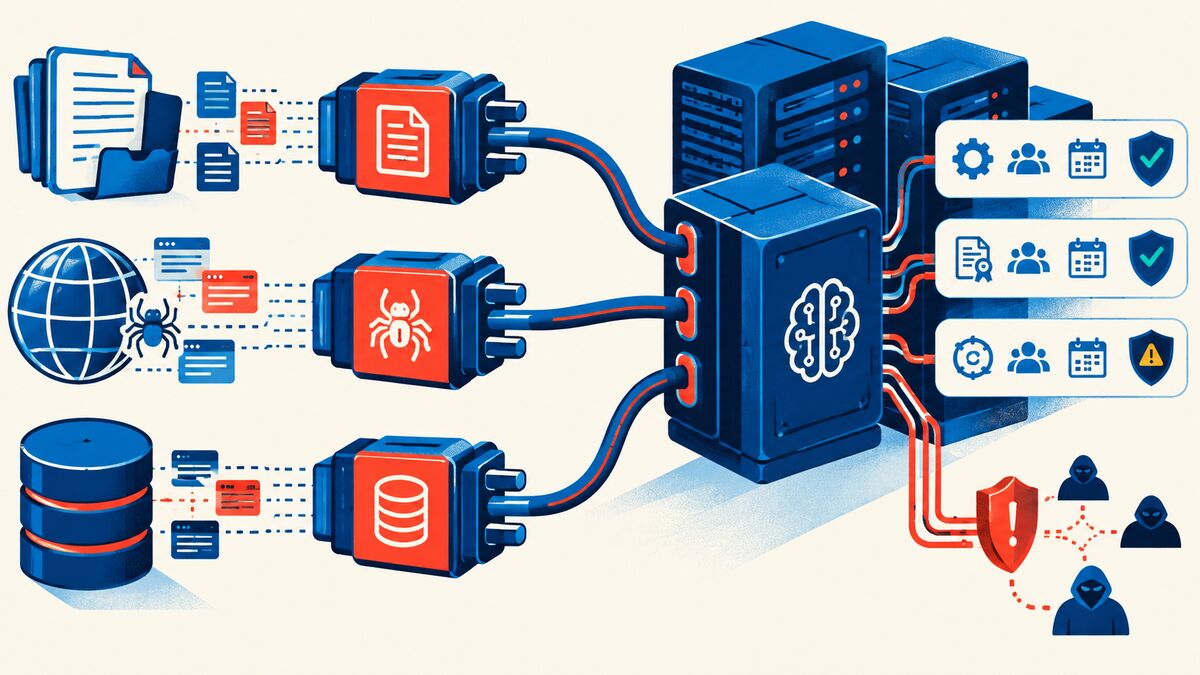
AI Extensions: docs, crawlers and databases are different trust decisions
A September 29 source review of Context7, Firecrawl MCP and Supabase MCP: setup, component licenses, maintenance, dated community counts and access risks.
 2026-09-28
AI Extensions: three official MCP servers, three different permissions
A September 28 check of Chrome DevTools MCP, Playwright MCP and GitHub MCP Server: official setup, license, activity and access boundaries.
 2026-09-27
AI Extensions: Safari control, Markdown vaults and biomedical queries
Three MCP projects checked September 27 for setup, license, activity and privacy. Community counts are observations, not quality ratings.
 2026-09-26
AI Extensions: AWS messaging skills, local memory and multi-model consultation
Three open-source agent tools checked for setup, license, activity and privacy on September 26. Stars are dated observations, not recommendations.
 2026-09-25
Fable review: faster preparation is not a faster or better agent
The supplied 23-task rerun halves pack overhead; scores hit a ceiling. The v0.20.0 cache bug was fixed, while licensing remains unclear.
 2026-09-25
AI Extensions: three tools with three kinds of power, and no reason to trust a star count
Three new open-source projects checked September 25 for setup, license, repository activity and security exposure. Stars are observations, not endorsements.
 2026-09-24
AI Extensions: one mouse mover, one config rewriter, one email box, one license flag
Four open-source extensions from the past two weeks, source-checked on September 24, 2026, with setup notes, licenses, dated activity snapshots, security caveats and one license warning.
 2026-09-23
Jev or Laya: where should an agent’s small decisions live?
Jev offers a polished hosted decision API and stronger large-option handling. Laya brings Apache-2.0 weights, local privacy, multilingual routing and lower measured self-hosted latency. Their benchmark claims are not yet apples to apples.
 2026-09-21
zcode-smart-skill review: a manager’s protocol written as one Markdown file
This ZCode skill coordinates fresh agents through a filesystem ledger, adversarial tests, checkpoints, and execution-based verification. Its strength is discipline; its limit is that Markdown cannot enforce its own rules.
 2026-09-21
ZaiMem code review: memory as infrastructure, with a deployment trap
ZaiMem combines deterministic vector recall, MCP tooling, project handoffs, document ingestion, meeting memory, and GitHub-backed snapshots. The code is unusually broad; durable hosting remains the decisive constraint.
 2026-09-21
RyzenDesk code review: serious security work with one open chat door
RyzenDesk packs ticketing, SLA, Kanban, wiki, analytics, automation, AI providers, email, Telegram, encrypted Git sync, and server RBAC into a self-hosted helpdesk. Build, type-check, and dependency audit pass; anonymous chat capability handling needs repair.
 2026-09-21
MemBox code review: a polished memory API with unlocked dashboard doors
MemBox pairs a clean five-language interface with REST memory, file storage, search, TTL, snapshots, webhooks, shares, analytics, batch operations, and optional GitHub persistence. The build passes, but unauthenticated dashboard routes expose tokens and destructive actions.
 2026-09-21
Deep-init AI review: real engineering, bigger claims than the code can carry
Deep-init AI combines a Telegram gateway, multi-provider fallback, encrypted tenant state, memory, reminders, voice, MCP, SSH tunnels, skills, and a polished console. Its tests and auth are substantial; cron authentication, bot-token URLs, licensing, and marketing claims need work.
 2026-09-21
14 alternatives to OpenClaw and Hermes Agent, tested as a business would run them
I inspected 15 repository snapshots behind 14 named business-agent candidates. Paperclip wins as a general workforce control plane; Octop leads for multi-user assistance; Founders OS and OdooPilot win focused jobs. Several other entries are promising, mislabeled, or unverifiable.
- 2026-09-16
AI Extensions daily: five open-source projects worth inspecting
A source-checked launch digest of skills, MCP references, browser agents, orchestration frameworks, and agent SDKs - with setup, license, maintenance, popularity signals, and security caveats.


